A practical framework for deciding when automation can create meaningful warehouse value — addressing operational constraints before equipment selection.
By Gys Mans
A practical framework for deciding when automation can create meaningful warehouse value.
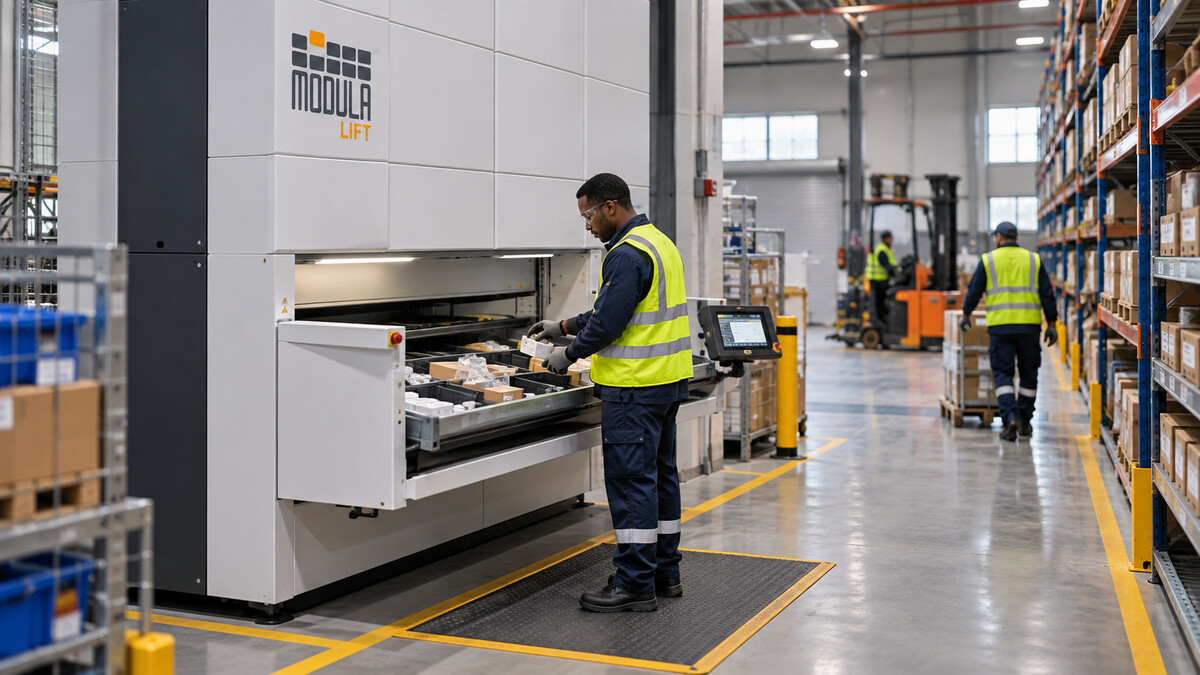
Warehouse automation business case: Modula Vertical Lift Module delivering goods-to-person picking productivity and up to 90% floor-space recovery.
Automation is a business decision before it is an equipment decision.
The strongest cases start with a specific operational constraint: insufficient space, repetitive travel, slow retrieval, accuracy risk, labour pressure or service constraints. The technology should address that constraint in a way the operation can sustain.
Customer question
What a business case should establish
Do we need more capacity?
Whether available footprint, storage density and flow constraints limit the current operation.
Can we move faster or more accurately?
Which processes create travel, searching, picking delay, errors or avoidable handling.
What will change operationally?
How roles, replenishment, inventory control, maintenance and safety procedures will work after go-live.
Is it commercially justified?
The investment, recurring cost, implementation disruption, expected benefit and timing under realistic assumptions.
Who this guide is for
Operations leaders, warehouse managers, supply-chain teams, finance managers and decision-makers assessing vertical lift modules, storage systems or related automation.
1. Identify the constraint worth solving
Automation is most effective where it relieves a material, repeatable constraint. A clear problem statement keeps the assessment focused and avoids investing in equipment that does not change the operating outcome.
Operational signal
What it may indicate
Evidence to review
Space is constrained
Storage density or layout limits are forcing overflow, extra handling or external space.
The process contains repeated, low-value movement between storage and work points.
Travel observations, picks per hour, walking distance, queue time.
Accuracy or control is under pressure
Manual storage and retrieval create avoidable errors, stock uncertainty or rework.
Error rates, inventory adjustments, rework, service complaints.
Service demand is changing
Growing SKU count, throughput or customer expectation is outpacing the current process.
Order profile, peak volumes, growth assumptions, cut-off performance.
Start with the flow, not the machine
Map the current journey from receipt to storage, replenishment, pick, pack and dispatch. The best automation opportunity usually sits at a repeatable point where movement, delay or error is visible in the data and on the floor.
A useful test
If the operational constraint disappeared tomorrow, what would improve: usable capacity, labour capacity, response time, accuracy, safety, service or working conditions? The answer should shape the business-case measures.
2. Assess the value levers
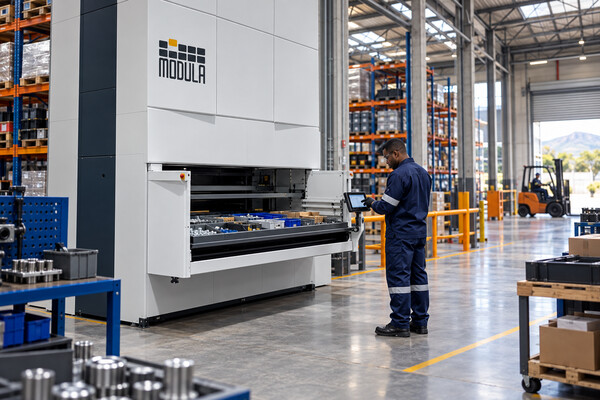
Goods to person picking using a Modula vertical lift module: trays are automatically delivered to an ergonomic picking bay, eliminating operator travel across aisles.
A warehouse automation business case normally combines several value levers. Assess each independently, use realistic implementation timing and avoid double-counting benefits that arise from the same change.
Value lever
How automation may contribute
Assessment input
Space & footprint
Higher storage density or better use of vertical space can reduce pressure on valuable floor area.
Current footprint, occupancy, alternative space cost, layout constraints.
Labour & travel
Goods-to-person workflows can reduce repetitive walking, searching and handling in suitable processes.
Task times, travel observations, role costs, peak workload.
Throughput & service
Faster, more consistent retrieval can support response time and cut-off performance.
Order profile, queue time, peak demand, service requirements.
Accuracy & inventory control
Controlled storage locations and system-directed activity can support better retrieval discipline.
Error, adjustment, rework and stock-availability history.
Safety & ergonomics
Reduced reaching, carrying and unnecessary travel may improve the working environment.
Labour capacity is not always direct labour saving
A reduction in walking or searching may create capacity, resilience or service improvement. Treat it as cash saving only where a cost can genuinely be removed or redeployed.
3. Build a credible commercial case
A transparent model shows the full cost of change, the operating assumptions, and the timing of benefits. It makes the decision easier to challenge constructively before capital is committed.
Model component
Include
Decision question
One-off investment
Equipment, installation, site works, integration, commissioning, training and project management.
What is required to achieve a safe, operational go-live?
Recurring cost
Maintenance, support, energy, software where applicable and internal operating effort.
What must be sustained after implementation?
Benefit timing
Ramp-up, training, process stabilisation and phased adoption.
When can each value lever reasonably be expected?
Risk & contingency
Site constraints, system interfaces, data quality, change management and downtime planning.
Which assumptions need validation before final approval?
Funding approach
Available capital, cash-flow priorities and suitable finance or rental structures.
How can the solution be aligned with commercial priorities?
Use sensitivity ranges
Test the assumptions that have the greatest impact: volumes, space value, task-time changes, adoption rate, implementation duration, operating hours and avoidable costs. A range-based model is more credible than one optimistic projection.
A finance model should follow the operating case
Once the operational scope is clear, DRS can explore the most suitable commercial structure. Any accounting, tax and ownership implications depend on the terms and applicable rules.
4. De-risk the implementation
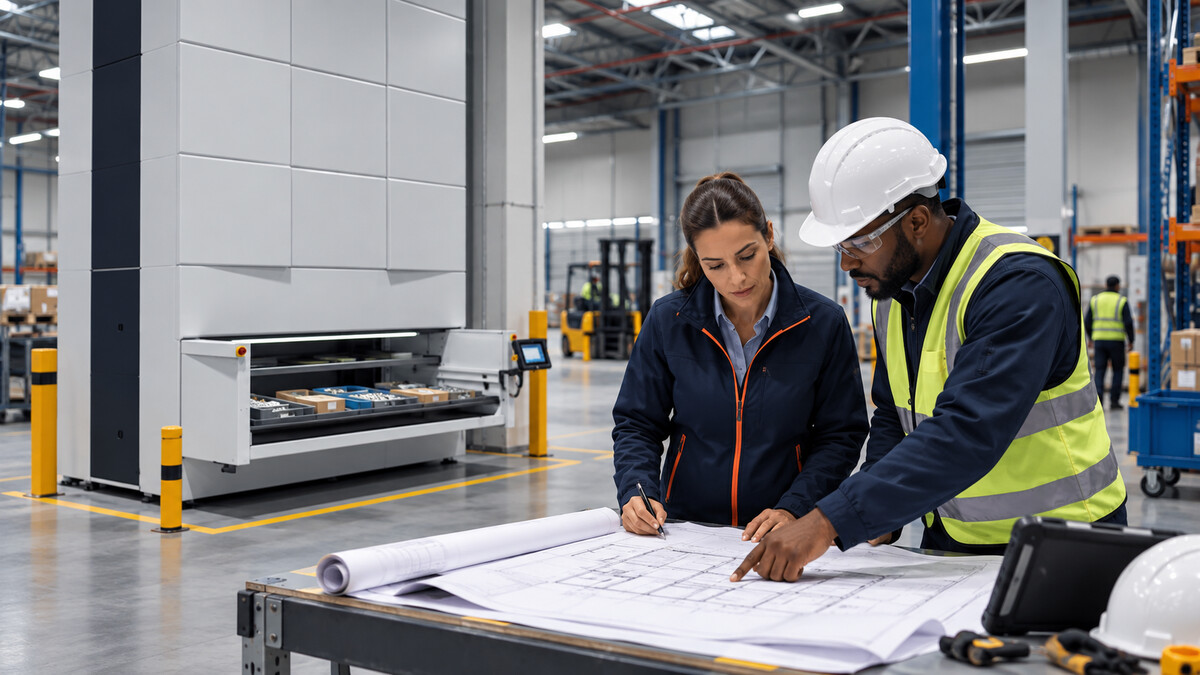
Planning a Modula vertical lift module implementation: operations leadership and engineering teams validate floor loading, ceiling clearance, and ERP/WMS integration blueprints.
A successful automation project combines the right equipment with practical process design, site readiness and adoption. Early validation protects both the business case and the go-live experience.
Stage
What to confirm
Practical output
Discovery
Process, volumes, SKUs, storage profile, constraints, service needs and site conditions.
Defined problem statement and fit-for-purpose concept.
Design
Layout, workflow, interfaces, safety, replenishment, exception handling and maintenance access.
Agreed operating design and implementation plan.
Business case
Investment scope, ongoing cost, value levers, timing, risks and commercial options.
Transparent decision model with assumptions and sensitivities.
Implementation
Site preparation, installation, testing, training, data and change management.
Controlled go-live plan with clear responsibilities.
Stabilisation
Performance, user adoption, system issues, maintenance and improvement actions.
Measured results against baseline and refinement priorities.
An anonymised operating pattern
A warehouse operation facing limited floor space and time-consuming retrieval first mapped its storage and picking profile. The assessment showed that a high-density, goods-to-person approach could address a concentrated process bottleneck. The team validated site requirements and task assumptions before selecting a phased implementation and commercial model.
5. A practical starting point with DRS
DRS can help connect warehouse requirements, automation options, asset finance and implementation planning into a decision grounded in the actual operating environment.
A focused first conversation
Which warehouse constraint is most costly or disruptive today: space, travel, throughput, accuracy, labour pressure or service?
What is the current storage profile, SKU characteristics, movement volumes and peak periods?
What does the existing process require in terms of floor space, travel time, handling, and operational effort?
What site, safety, system and change-management requirements could affect implementation?
Which value levers can be measured today, and which assumptions need pilot or design validation?
From business case to an informed decision
DRS can develop a detailed assessment once relevant operational, site and commercial information is available. The assessment can consider process requirements, automation scope, implementation plan, value levers and the most suitable commercial structure.
Important note
This guide is intended as general information, not a guarantee of operational, financial or technology outcomes. Any solution scope, investment, commercial terms and expected benefits should be confirmed through joint discovery, technical assessment and appropriate professional advice.
DYNAMIC RENTAL SOLUTIONS
Asset intelligence for productive business growth.